SM REALIVE
Master-Client network architecture achieving <50ms synchronization accuracy across standalone VR headsets.
VR Software Engineer
The Challenge
In a shared VR concert experience with 5+ Meta Quest 3 devices, standard network replication caused Frame Desynchronization (Drift) of >100ms due to variable packet arrival times. This latency variance caused severe motion sickness and broke immersion. The challenge was to ensure that VideoPlayer.Play() triggers at the exact same physical moment on all devices, regardless of individual network jitter.
Architecture & Deep Dive
System Architecture
Master-Client NTP Sync · Play / Pause / Seek · HMS Fleet Management
swipeKey Implementation
// Future Timestamp Execution Strategy
public void SchedulePlayback(long targetServerTime) {
    // 1. Calculate precise local offset using RTT
    // timeOffset = ServerTime - LocalTime - (RTT / 2)
    long localTargetTime = targetServerTime - this.timeOffset;

    // 2. Calculate exact wait duration
    // WaitTime = TargetTime - CurrentLocalTime
    double waitSeconds = (localTargetTime - DateTime.UtcNow.Ticks) / 10000000.0;

    if (waitSeconds > 0) {
        // 3. Schedule execution
        StartCoroutine(ExecuteAtTime(waitSeconds, () => {
            videoPlayer.Play(); // Triggers at the exact same physical moment
        }));
    } else {
        // Fallback: Seek to correct position if packet arrived late
        videoPlayer.time += Math.Abs(waitSeconds);
        videoPlayer.Play();
    }
}
Technical Trade-offs
Initially, I used socket.broadcast.emit to sync time, but this flooded the main thread of client devices (O(n^2) message complexity), causing stuttering. I refactored the architecture to use Targeted Emits (io.to(guestId).emit). This reduced CPU overhead by selectively sending correction data only to clients that drifted beyond the ±3 frame threshold, prioritizing network stability over constant updates.
Reliability & Validation
Error Handling Strategy
Developed a real-time CSV logging system to record CurrentFrame from all clients during stress tests. Implemented a Fail-Safe LOD (Level of Detail) system where devices exceeding 150ms RTT automatically downgrade video resolution to maintain synchronization priority. Disconnected clients can hot-swap back into the session using the calculated global time offset without restarting the experience.
Impact & Collaboration
Achieved ±1~2 Frame Synchronization (approx. 33ms) accuracy across 5 concurrent devices, validated through frame-logging metrics. This architecture was deployed commercially for the "SM REALIVE" K-Pop VR Theater, where the automated Docker/Kiosk Mode deployment pipeline reduced on-site setup time by 50%.
Frame Index Comparison
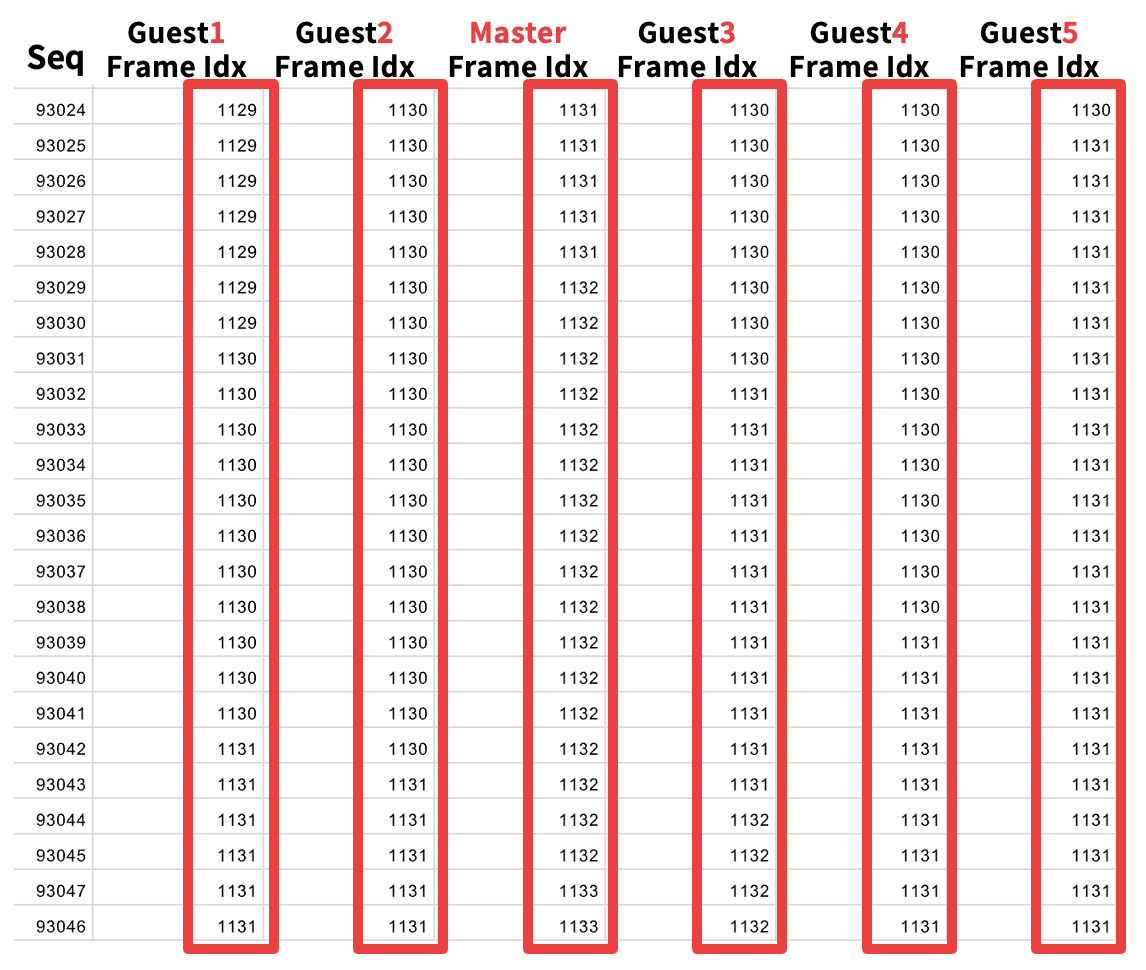
Frame Index Comparison
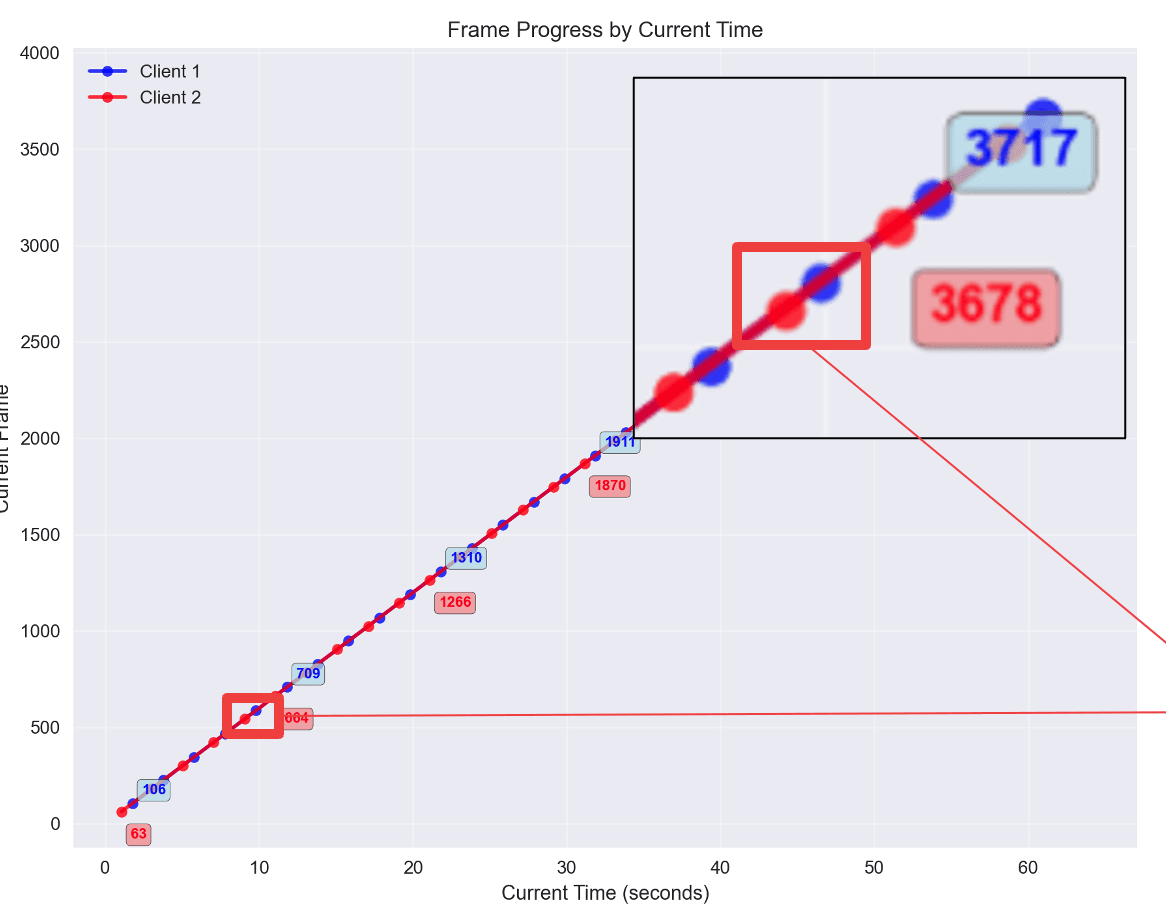
Frame Index Comparison